


How Adaptive Cruise Control Improves Safety, Comfort, and Fuel Economy
Adaptive Cruise Control (ACC) is a driver-assist feature that holds a set speed and automatically adjusts to traffic using sensors to keep a safe gap. Below, we explain what ACC does, how radar and cameras make it work, the real safety and comfort benefits drivers see, how it can help fuel economy, and why post-repair calibration is critical to keep systems reliable. Many drivers find ACC reduces rear‑end crashes and driver fatigue — but those gains depend on correctly aligned sensors and OEM-calibrated repairs after collisions. We walk through ACC’s systems, summarize safety gains with an easy-to-read table, show comfort and efficiency examples, and spell out when ADAS calibration is needed. We also explain how Prime Time Collision Center in Glendale, CA supports ACC maintenance and insurance coordination while focusing on restoring system performance and safety. Throughout, helpful search phrases like adaptive cruise control, ACC safety features explained, ADAS calibration near me, and adaptive cruise control repair Glendale are woven in naturally so readers can find local, technical repair guidance.
What Adaptive Cruise Control Is — and How It Works
Adaptive Cruise Control keeps a preset speed but changes acceleration and braking to maintain a safe following distance. It combines radar and forward‑facing camera data to measure relative speed and object position, then sends that information to the vehicle’s ECU, which adjusts throttle and brakes to match traffic. That sensor-to-actuator loop smooths speed changes and handles stop‑and‑go situations where the car may need to stop and resume on its own. Knowing this helps explain why precise sensor alignment and correct software calibration are essential for predictable behavior and consistent safety.
How ACC Is Different from Traditional Cruise Control
Traditional cruise control simply holds the speed you set, regardless of traffic. ACC, by contrast, actively manages distance and adjusts speed based on what it senses ahead. ACC can slow and reaccelerate automatically, offering selectable gap settings so you choose the following distance. Many systems also work with automatic emergency braking to reduce impact risk. Those extra capabilities make ACC both a comfort and safety feature — and they create a reliance on sensors and calibration that simple cruise control doesn’t have.
What Sensors and Technologies Make ACC Possible
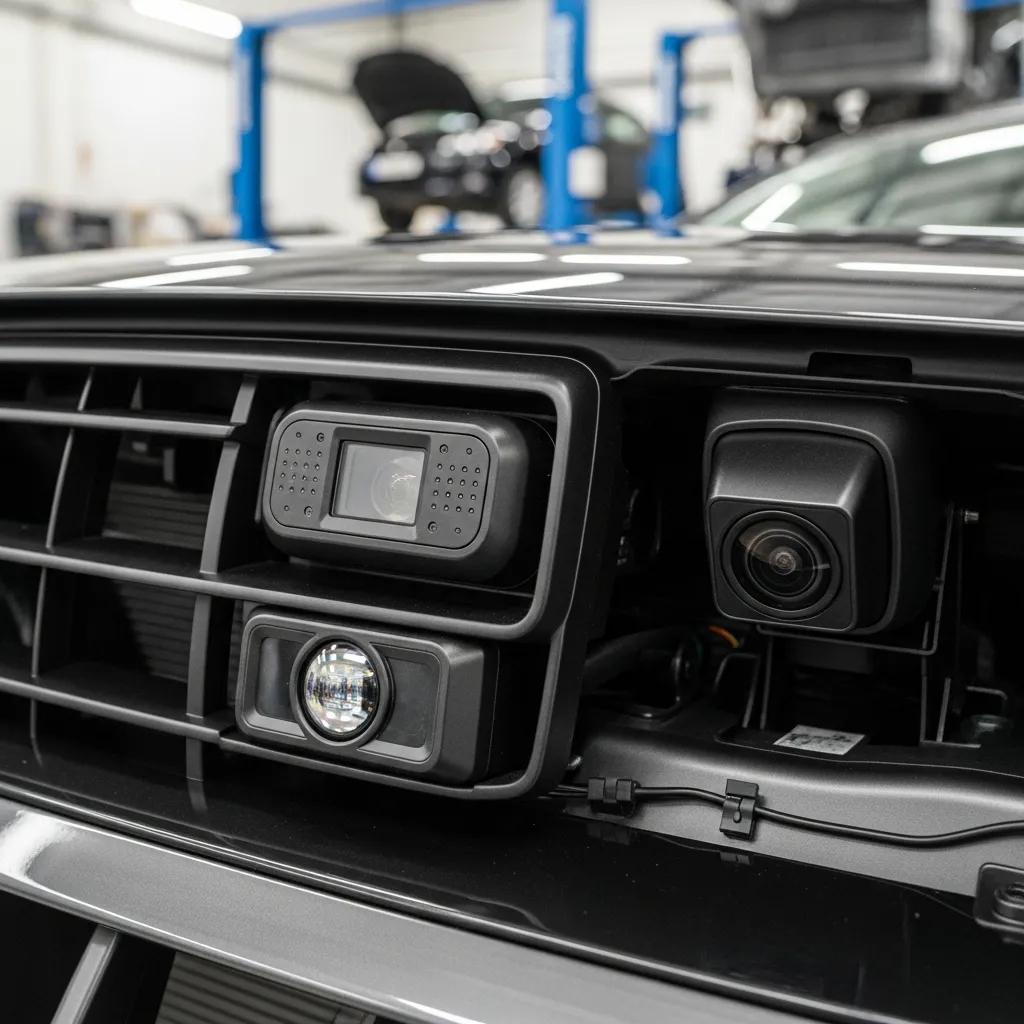
ACC depends on several components: radar sensors for distance and closing speed, forward cameras for object recognition and lane context, and an ECU that fuses those inputs to command throttle and brakes. Radar units usually sit low in the grille or bumper and measure range; cameras mount near the windshield to read lanes, brake lights, and pedestrians. Sensor fusion software combines both feeds to reduce false detections and improve tracking, and actuators carry out the ECU’s commands. Each part plays a role in the system’s reliability, so keeping mounts aligned and validating performance after repairs is crucial.
Key Safety Benefits of Adaptive Cruise Control
ACC lowers crash risk by keeping safe following distances, smoothing speed changes, and automatically decelerating when traffic slows. Because it continuously watches the road and often reacts faster than a human driver, ACC can reduce rear-end collisions and lessen impact severity. Studies show systems that pair ACC with forward collision warning and automatic emergency braking produce measurable drops in crash rates and injuries. The table below lays out ACC’s safety functions and the practical value they provide to drivers.
ACC delivers several distinct safety functions that work together to protect drivers and other road users.
| Safety Function | How It Works | Driver Benefit |
|---|---|---|
| Following-distance maintenance | Sensors keep a set gap from the vehicle ahead and adjust speed automatically | Reduces the chance of rear-end crashes |
| Automatic deceleration | The ECU applies brakes when closing too quickly on a lead vehicle | Lessens impact severity |
| Stop-and-go control | Low-speed stop, hold, and resume functions | Fewer low-speed collisions and driver errors |
| Integrated warnings | Cameras and radar trigger alerts for imminent hazards | Gives drivers extra time to react |
This side-by-side view shows how ACC’s coordinated features translate into everyday safety benefits and why keeping sensors accurate through proper calibration matters.
How ACC Helps Prevent Rear‑End Collisions
ACC reduces rear‑end crashes by continuously monitoring distance and closing speed to the car in front, then slowing the vehicle if the gap closes too fast. Where a human driver might be late to react, ACC detects braking earlier and applies throttle reduction or braking more consistently. Removing variability from following behavior lowers the odds of sudden-stop incidents that cause rear-end impacts. Because this depends on accurate sensor data, even small misalignments can delay or weaken the system’s response.
The Roles of Radar and Camera Sensors in ACC Safety
Radar and cameras complement one another: radar gives accurate range and relative speed, while cameras help classify objects and understand lane position. Radar works well in low light and many bad-weather situations but can be affected by physical damage or blockage; cameras are great for visual cues but can struggle with glare or poor visibility. Sensor fusion cross-checks these inputs, and calibration makes sure the physical aim and software maps align so radar returns and camera views match up. Proper validation after repair prevents mismatches that could lead to false alarms or missed hazards.
How ACC Reduces Driver Fatigue and Boosts Comfort
ACC takes over repetitive speed and gap-management tasks on long trips or in heavy traffic, cutting both physical and mental workload for drivers. By automating longitudinal control and keeping speed transitions smooth, ACC lets drivers focus more on lane position and scanning for hazards instead of constant micro‑adjustments. That relief reduces stress, improves comfort, and helps maintain steadier attention over longer drives. The benefits are most obvious on busy highways and long commutes, where predictable system behavior helps drivers anticipate how the vehicle will react.
How ACC Helps in Stop‑and‑Go Traffic
Stop-and-go ACC modes bring the car to a full stop when needed and resume automatically when traffic moves, which dramatically reduces brake and throttle inputs. During rush hour, this prevents repeated, tiring pedal actions and lowers leg fatigue. The system’s steady responses also cut down on jerky speed changes and reduce minor fender‑bender risk in slow traffic. Proper calibration keeps these low-speed behaviors smooth and reliable after any front-end repair.
How ACC Lowers Mental Load on Long Drives
By keeping a set speed and following distance, ACC removes the constant small judgments about pacing and gap selection. That allows drivers to focus mental energy on scanning, navigation, and higher‑level decisions. Remember: ACC assists — it’s not an autopilot — so you must stay engaged and ready to take control. When sensors and software are calibrated to OEM specs, drivers can trust the system’s intervention points and use cognitive effort for situational awareness instead of micro-managing speed.
Can ACC Improve Fuel Efficiency?

ACC can save fuel by smoothing acceleration and braking and by holding steady highway speeds that avoid energy‑costly spikes. It cuts the number and intensity of acceleration events, which helps fuel economy in mixed-speed driving. On rolling roads and in stop-and-go traffic, ACC’s predictive throttle control — when paired with engine management — can reduce fuel wasted during frequent speed changes. Real-world gains vary with traffic, powertrain type, and how conservatively the ACC is set; you’ll usually notice the biggest improvements on steady highway stretches.
How Keeping a Consistent Speed Saves Fuel
Repeated acceleration wastes energy because you must rebuild kinetic energy each time. ACC promotes smoother speed profiles and fewer sudden throttle spikes, lowering average fuel use compared with aggressive human driving. Maintaining a gradual closing speed and steady cruise helps reduce transient fuel consumption, especially in non-hybrid vehicles. Drivers who use eco-minded set speeds and account for terrain see the best results, though exact mileage gains depend on vehicle and route.
What Smooth Acceleration and Braking Do for Mileage
Gentle acceleration keeps the engine in efficient operating bands, and softer braking reduces stop-start cycles that cost fuel. Besides helping economy, smoother driving lowers brake wear and heat buildup, which can extend service intervals. In city driving, ACC moderates overreactions that spike fuel use, so you can see small but meaningful savings. Consistent benefits depend on reliable sensors and control logic — another reason ADAS calibration matters after repairs that affect sensor location or vehicle geometry.
Why Expert Repair and Calibration Matter for ACC
Yes — calibration is required after many collisions, windshield replacements, suspension work, or any repair that changes sensor mounts or vehicle geometry. Misaligned sensors can give wrong distance, angle, or classification data. When sensors fall out of tolerance, ACC decisions can be delayed, show false alerts, or miss hazards — directly undermining safety and comfort. OEM repair procedures and certified technicians follow factory calibration steps that restore sensor aim, software settings, and verification tests so the system behaves predictably. Skipping calibration risks degraded ACC performance and can affect insurance or warranty outcomes; following OEM and I‑CAR standards is a necessary safety step.
Note: recalibration triggers and risks differ by repair type and affect ADAS reliability.
| Trigger for Recalibration | When Recalibration Is Needed | Risk If Not Calibrated |
|---|---|---|
| Front-end collision | Damage to bumper, grille, or sensor mounts | Wrong distance readings; delayed braking |
| Windshield replacement | Camera modules behind the glass were disturbed | Lane and object misclassification |
| Suspension or steering repair | Changes to ride height, roll/pitch, or wheel alignment | Incorrect horizon or angle references |
| Sensor replacement | New hardware installed or repositioned | Software and sensor mismatch |
This table highlights typical events that call for ADAS/ACC recalibration and the safety risks of skipping that step — showing why factory‑aligned procedures matter.
When Should ADAS Be Calibrated After a Collision?
ADAS calibration is necessary whenever a collision affects sensor housings, mounting points, windshield camera position, or the vehicle’s suspension and steering geometry. Those changes shift the sensor reference frames ACC uses. Inspections include visual checks of mounts, confirming windshield camera seating, and measuring ride height, followed by static or dynamic calibration steps to re‑establish alignment. Insurance carriers often require documented calibration to confirm safety systems were restored; skipping it can leave you with degraded ACC responses. Certified technicians and OEM procedures ensure reliable recalibration outcomes.
How OEM Repairs and I‑CAR Platinum Technicians Keep ACC Working Right
I‑CAR Platinum certification shows a shop’s technicians have the training and shop processes to meet industry best practices for collision repair and ADAS calibration. OEM procedures specify calibration targets, verification tests, and acceptable tolerances for sensor aim; following those procedures reduces residual errors in ACC performance. Trained techs document calibration steps and run validated test drives before returning the vehicle, protecting safety and warranty coverage. That combination of training and OEM alignment gives measurable confidence that ACC features work as intended after repair.
For local drivers, Prime Time Collision Center in Glendale, CA handles OEM-focused repairs and ADAS calibration with I‑CAR Platinum technicians who follow the manufacturer procedures described above.
How Prime Time Collision Center Helps with ACC Maintenance and Repair
At Prime Time Collision Center we deliver OEM-quality collision repairs, ADAS calibration, and hands-on support through the insurance process to restore ACC systems to factory standards. Our I‑CAR Platinum technicians inspect sensor mounts, perform static and dynamic calibrations, and validate system performance with test drives. We work with all major insurers to prepare documentation and estimates, and we offer free estimates plus 24/7 towing assistance to make post-accident steps easier for local drivers. These services give Glendale vehicle owners access to the technical support needed to get ACC back to reliable operation.
The table below shows our ADAS/ACC support services and the customer benefits they provide.
| Service | What It Does | Customer Benefit |
|---|---|---|
| ADAS inspection | Checks sensor condition, mounts, and software status | Finds calibration needs early |
| Static calibration | Aligns sensors using factory procedures | Restores correct sensor geometry |
| Dynamic calibration & test drive | Verifies behavior under real driving conditions | Confirms ACC performance and safety |
| Insurance assistance | Prepares estimates and coordinates with major insurers | Simplifies claims and supports OEM repairs |
What ADAS Calibration Services We Offer for Adaptive Cruise Control
Prime Time provides a clear sequence of ADAS services: a detailed inspection of ACC sensors and mounts, static calibration following OEM methods, and dynamic verification under controlled driving conditions. The inspection finds physical damage or misalignment; static calibration brings sensors back to the vehicle reference frame; dynamic calibration confirms real-world behavior and fine‑tunes settings as needed. Post‑calibration checks include diagnostics and a documented test drive to ensure ACC responses meet manufacturer expectations. These steps help ACC return to reliable operation so drivers regain the safety and comfort benefits described earlier.
How Our Insurance Handling Helps Get ACC Repairs Approved
We streamline claims by creating OEM‑aligned estimates, documenting calibration and verification steps, and communicating repair needs to major insurers so required ADAS work gets authorized. Prime Time’s coordination reduces back‑and‑forth, helps ensure parts and procedures follow OEM guidance, and supports customers through estimate preparation and claims follow-up. That advocacy increases the chance that ADAS calibrations and OEM repair steps are approved and completed, preserving system performance and driver safety. Glendale drivers needing ACC inspection or calibration after a collision can contact Prime Time Collision Center for a documented, certified evaluation.
- Schedule an inspection: Book an ADAS inspection to see if ACC calibration is required.
- Document repairs: Keep records of calibration and verification for insurance and warranty purposes.
- Validate performance: Confirm ACC behavior with a documented test drive to restore confidence in system safety.
These steps outline the path from damage assessment to restored ACC functionality and show why certified repairs matter for safety and insurance compliance.
Frequently Asked Questions
What are the limitations of Adaptive Cruise Control systems?
ACC improves safety and comfort but has limits. It can struggle in heavy rain, snow, fog, or other conditions that reduce sensor performance. ACC also isn’t suited for every situation — it may be less effective on very winding roads or in some stop‑and‑go scenarios. Drivers must stay attentive and ready to take control; ACC assists, but does not replace active driving.
Can Adaptive Cruise Control be retrofitted to older vehicles?
Retrofitting ACC is sometimes possible but can be complex and costly. It usually requires compatible sensors, wiring, and an ECU that supports ACC functions. Feasibility depends on the vehicle’s make and model. Professional installation and calibration are essential to ensure the system works safely, so consult a specialist to assess compatibility and cost.
How does weather affect the performance of Adaptive Cruise Control?
Weather can affect ACC performance. Rain, snow, fog, and ice can block or degrade sensor readings, causing inaccurate detections or limited functionality. Heavy rain can scatter radar signals and snow can block camera views. In poor weather, be cautious and be prepared to turn off ACC if conditions make sensor readings unreliable.
Is Adaptive Cruise Control safe for highway driving?
Yes — ACC is generally well-suited to highway driving, where traffic is more consistent and the system can maintain safe gaps and smoother speeds. Still, drivers must remain alert and ready to intervene, especially during lane changes or shifting traffic. Proper calibration and maintenance help ensure ACC stays reliable on highways.
What should I do if my Adaptive Cruise Control system malfunctions?
If ACC malfunctions, check for dashboard warnings and take the vehicle to a certified ADAS technician. Technicians can run diagnostics to find the issue and recommend repairs or recalibration. Prompt attention and routine maintenance are important to keep ACC safe and functional.
How can I ensure my Adaptive Cruise Control system is properly calibrated?
Have ACC inspected and calibrated by certified technicians following OEM guidelines, especially after repairs that affect sensor position such as collisions or windshield replacements. Regular checks can catch misalignments early. Keep calibration records for warranty and insurance purposes so your ACC system remains safe and reliable.
Conclusion
Adaptive Cruise Control can meaningfully improve safety, comfort, and fuel efficiency when sensors and software are working as intended. Proper calibration and certified repairs let you get the most from those benefits. If you’re in Glendale, CA, Prime Time Collision Center offers OEM-focused ACC support — from inspections and calibrations to insurance coordination — to help restore your vehicle’s safety systems. Schedule an inspection to make sure your ACC is ready to perform.