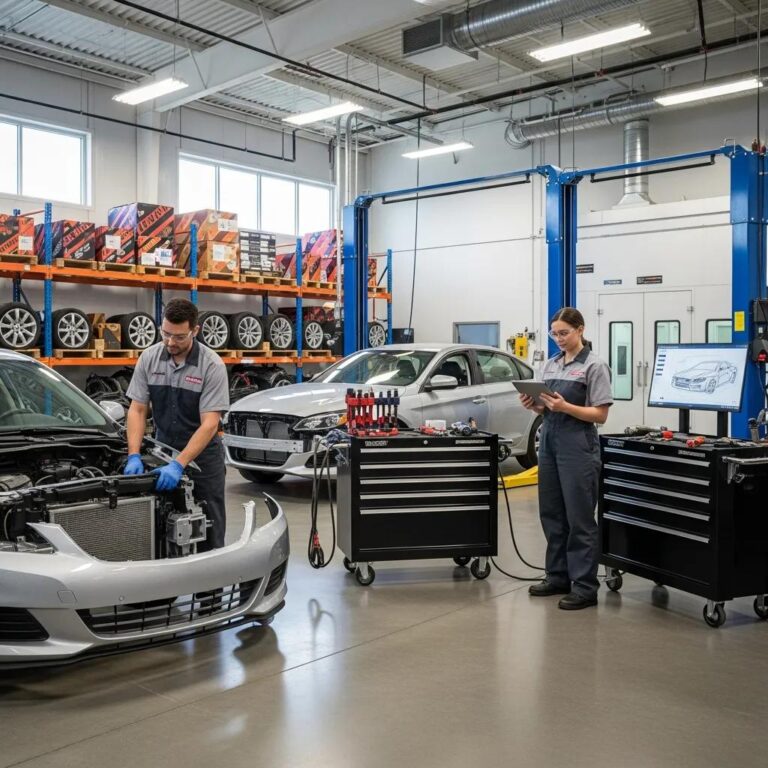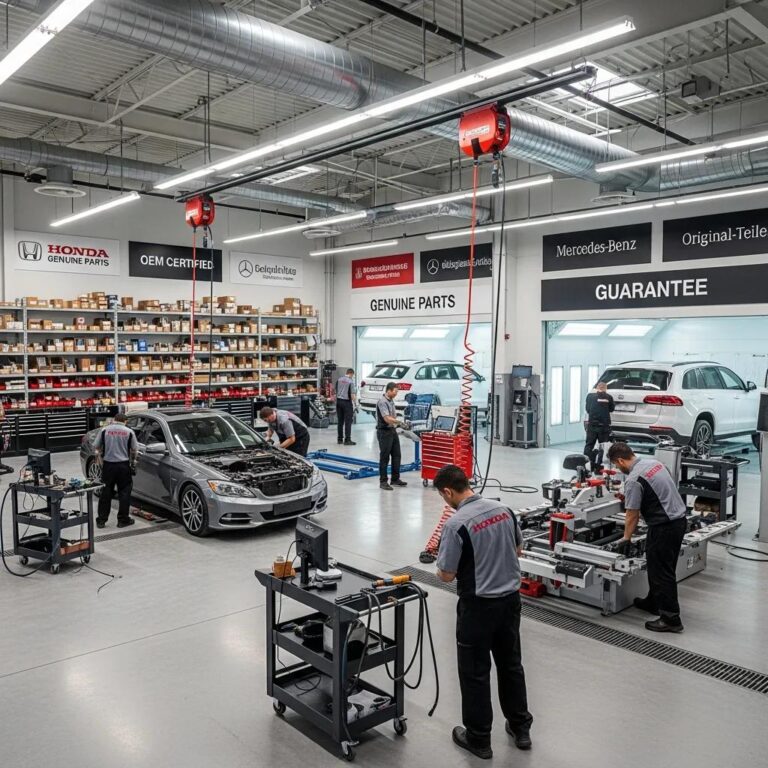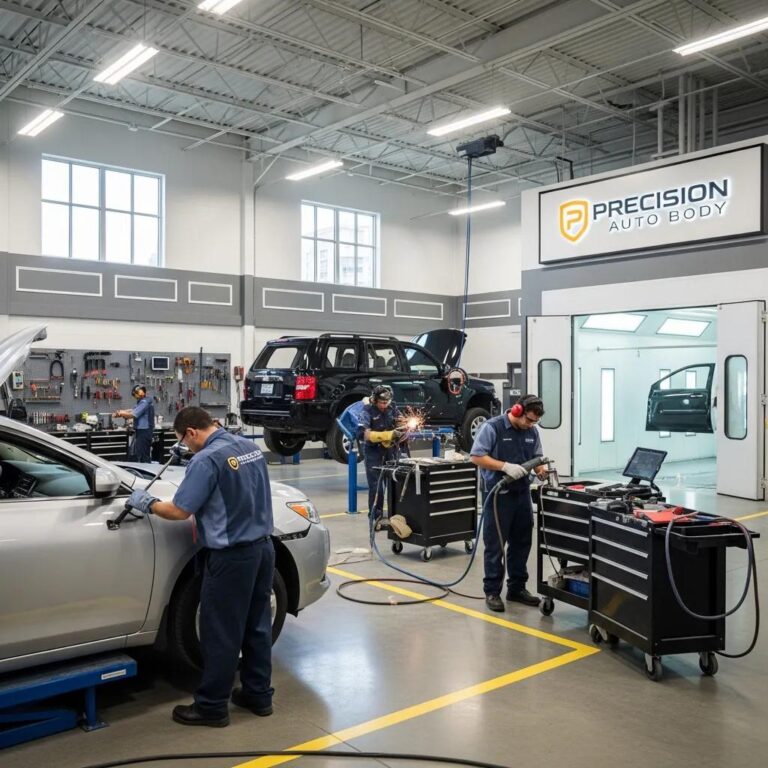
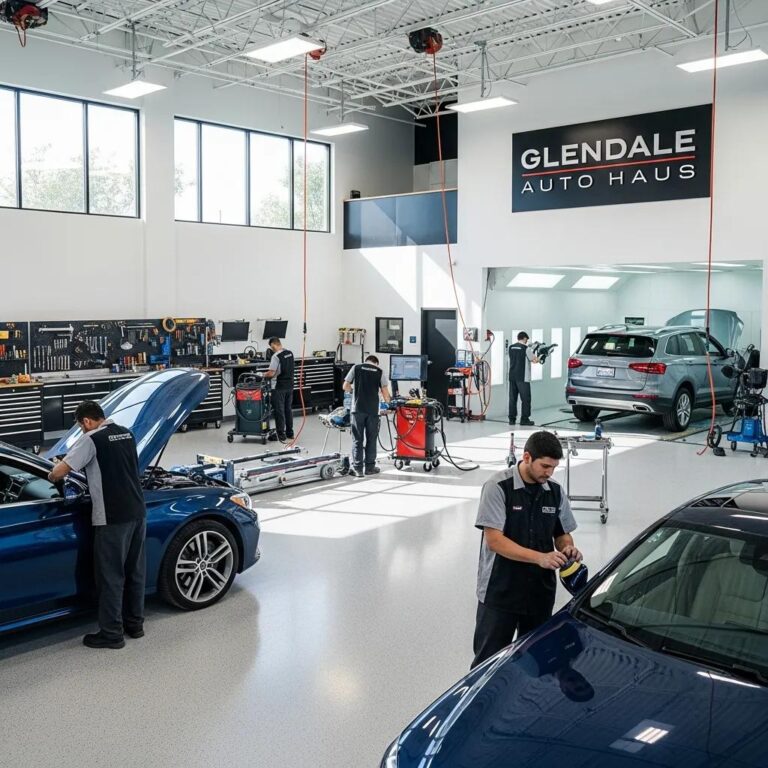

Domestic Car Body Repair Done Right — OEM-Level Care for American Vehicles
“Expert domestic car body repair” means restoring American-made vehicles to factory standards so they drive, protect and look the way the manufacturer intended. This guide walks you through why OEM-level repairs matter for Ford, Chevrolet, Dodge, Tesla and other domestic models, the step-by-step repair process after a collision, and the core services — from paintless dent repair to ADAS calibration and frame straightening — that deliver safe, lasting results. We simplify warranty questions, insurance conversations, and the technical checks technicians use to restore structural integrity. Read on to learn how our certified team evaluates damage, why OEM parts and proper calibration protect resale value, and what to do immediately after a crash to protect your claim. We then map services, explain the repair workflow, and list the right questions to ask your shop so you can make clear, confident decisions for domestic car repairs in Glendale and beyond.
What Are Expert Domestic Car Body Repair Services and Why Are They Essential?
Expert domestic car body repair means collision and structural work performed to manufacturer (OEM) procedures so safety systems, fit and finish are restored correctly. That includes replacing or repairing damaged parts with approved materials and methods, then verifying systems like airbags and ADAS are calibrated to spec. The difference between a good fix and an OEM-consistent repair is traceability, precise frame measurements and documented calibration — all of which preserve the vehicle’s safety intent and resale value. Industry guidance makes clear that alignment and ADAS recalibration aren’t optional after many impacts, because sensors and cameras need exact geometry to work. Knowing why OEM-level repairs matter helps you prioritize safety and long-term value when choosing a shop.
Domestic collision repair restores a vehicle’s structure and occupant protection using procedures developed for American platforms. Many domestic models mix high-strength steel, aluminum and engineered plastics, each requiring specific welding, bonding and replacement techniques to keep crashworthiness intact. Following manufacturer repair instructions ensures correct load paths, proper fastener torque and approved joining methods — things that affect how the vehicle manages crash energy. For example, replacing a crumple-zone rail with an uncertified method can change crash behavior and airbag timing. That technical reality is why certified protocols and trained technicians matter after an impact.
Preserving safety and resale value comes down to three priorities: using OEM parts, following manufacturer procedures, and validating safety systems after repairs. OEM parts match original tolerances and materials so fit and load distribution remain correct; aftermarket parts can differ in metallurgy or dimensions and may affect long-term durability. Proper ADAS recalibration after body or glass work restores sensor alignment so lane-keeping, automatic braking and adaptive cruise work as intended. Keeping documented OEM repairs and parts traceability also helps preserve warranties and reassures future buyers that the vehicle was returned to manufacturer specs. The next section explains common OEM certification programs and what they mean for domestic car owners.
Three primary benefits of OEM-quality domestic car body repair:
- Safety restored through correct structural repairs and ADAS procedures.
- Warranty and resale protection with documented OEM parts and processes.
- Long-term reliability by using manufacturer-approved materials and techniques.
Which OEM Certified Domestic Auto Repair Services Does Prime Time Collision Center Offer?
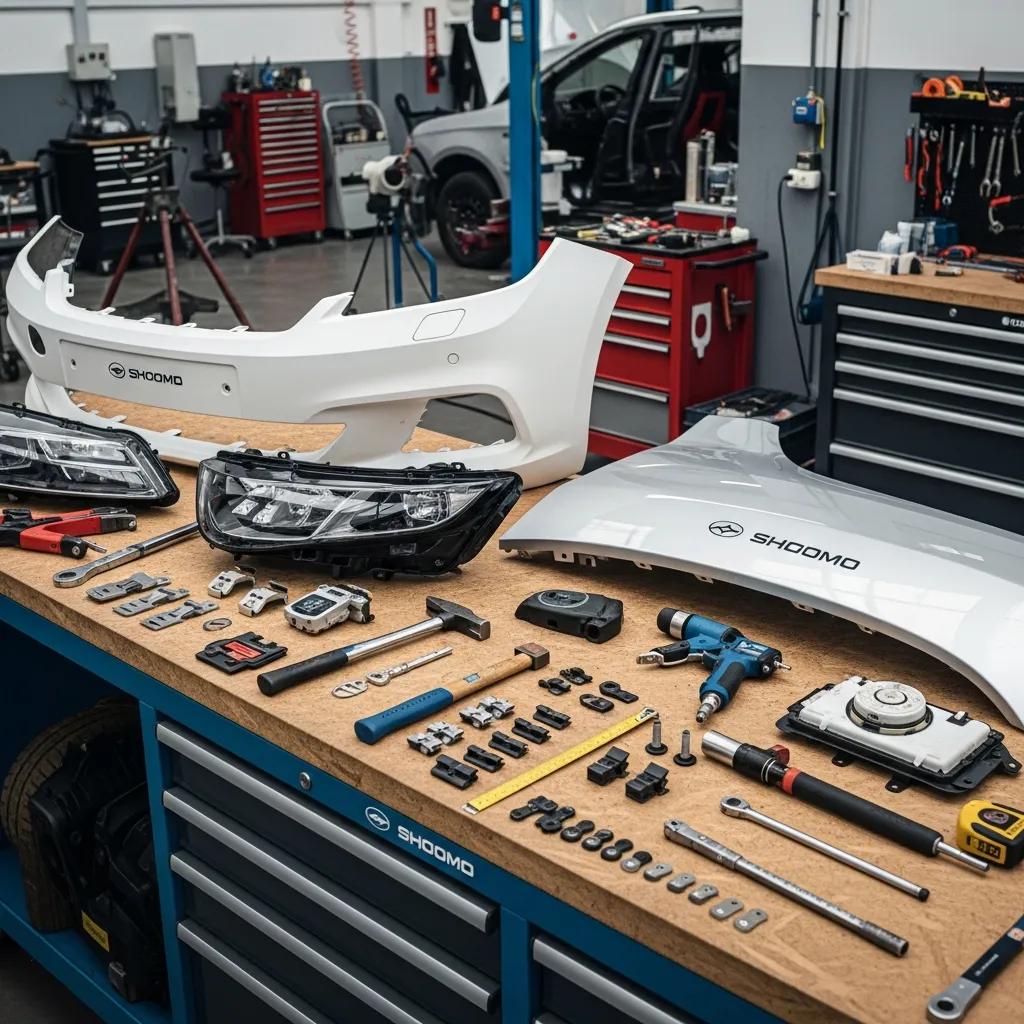
OEM-certified domestic repairs follow a shop’s commitment to manufacturer procedures: the right equipment, documented repair steps, trained technicians and parts traceability so vehicles are restored to factory intent. Certification work typically requires specialized tools, training records and a parts-sourcing process that customers can verify. When you’re comparing shops for Ford, Chevrolet, Dodge or Tesla work, ask about technician training, ADAS calibration capability and the shop’s ability to source and install genuine OEM components. Clear answers about parts and documented repair steps give you confidence the work will match the original engineering intent.
Intro to brand programs and customer impact:
| Brand | Certification/Program | What it means for the customer |
|---|---|---|
| Ford | Manufacturer repair procedures and parts traceability | Repairs follow Ford guidance; OEM parts help preserve fit and warranty considerations |
| Chevrolet | GM-aligned processes and ADAS verification | Ensures sensors are recalibrated and assemblies meet GM specs |
| Dodge | Standards for heavy-frame and safety-component repair | Maintains structural integrity for trucks and SUVs after frame work |
| Tesla | EV-specific body, battery and ADAS protocols | Requires EV-certified procedures for battery protection and sensor calibration |
This table shows how program alignment translates into clear benefits and why certification matters for domestic vehicle owners.
Before you authorize repairs, confirm these four items:
- Does the shop use OEM parts for structural components, body panels and safety modules?
- Are technicians trained to perform ADAS calibration and EV battery/high-voltage procedures?
- Will the written estimate specify parts sources and required calibration steps?
- Will the shop provide documentation and parts traceability when the vehicle is returned?
Our team includes I‑CAR Platinum certified technicians, we work with all major insurance companies, and we offer free estimates, appointment scheduling and 24/7 towing coordination. With multiple Glendale locations, we emphasize OEM parts and certified repairs, and we stand behind our workmanship — ask us about our warranty details.
What Is the Domestic Car Collision Repair Process at Prime Time Collision Center?
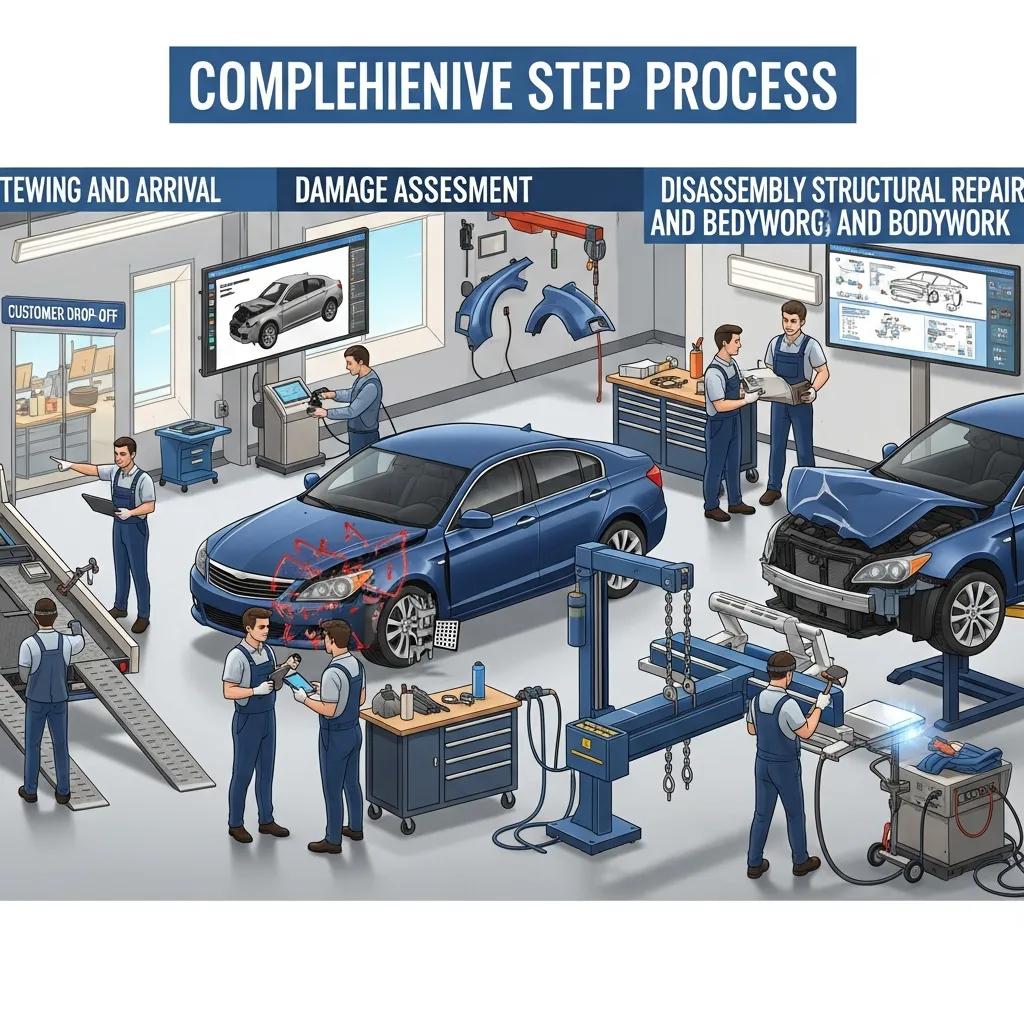
Our domestic car collision repair follows a clear, repeatable sequence: tow and safety intake, detailed damage estimate, parts sourcing and repair planning, structural and mechanical repairs, ADAS calibration and finishing, then final quality assurance and vehicle handover. Each stage exists to restore crashworthiness and functionality, addressing visible damage and the underlying systems — steering geometry, suspension alignment and driver assistance technologies.
Open communication at every step keeps you informed and smooths interactions with your insurer. The table below summarizes each stage, what we do, and what you should expect so you know who’s responsible for what during the repair.
| Step | What the shop does | What the customer should expect |
|---|---|---|
| Towing & intake | Receive vehicle, secure it and document initial damage | Confirmation of safe storage and an intake report |
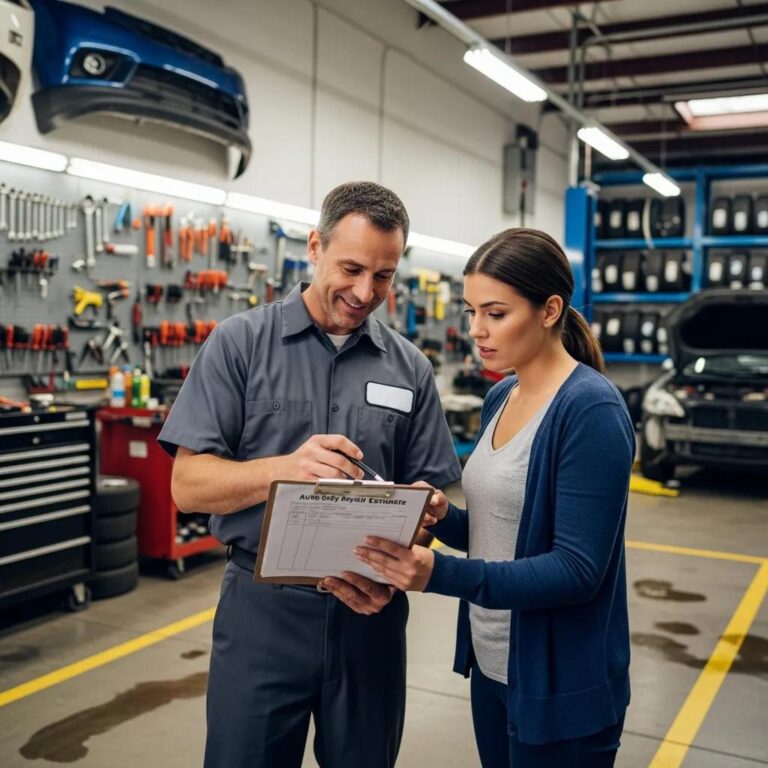
| Estimate & insurance review | Complete damage appraisal and coordinate with your insurer | A written estimate and guidance for the claim process |
| Parts & planning | Source OEM parts and create a repair schedule | A timeline and status updates on parts |
| Repair & calibration | Perform structural repairs, paint work and ADAS recalibration | Quality checks, test drives and system verification |
| Final QA & handover | Inspect systems, document repairs and prepare delivery | Vehicle pickup with repair documentation |
This roadmap helps you follow progress and ask the right questions along the way.
Right after a collision, take these practical steps to protect safety and your claim: prioritize personal safety and move to a secure spot, photograph the scene, exchange information with other parties, and notify your insurance company. Collect vehicle documents like registration and prior repair records, and request a written estimate from a repair shop to keep the claims process transparent. Arrange transportation — many shops coordinate towing and rentals — and save copies of all communications. These steps reduce delays and help your repair move forward smoothly.
Insurance coordination typically requires close communication between the shop, insurer and vehicle owner to confirm scope and parts sourcing. We prepare a detailed estimate that cites OEM parts and diagnostic findings, then submit it to the insurer for approval. If an insurer questions OEM parts or procedures, we advocate for manufacturer-recommended repairs with documented guidance. Expect possible supplemental estimates for hidden damage and discussions about OEM versus aftermarket parts; manufacturer recommendations support choosing OEM where safety is involved. Clear documentation and proactive communication improve claim outcomes and help ensure the vehicle is repaired correctly. For immediate help or to schedule a local estimate in Glendale, call us at (818) 396-4997.
What Specific Domestic Car Body Services Are Available for American Vehicles?
We offer a full suite of domestic car body services that address cosmetic and structural damage while ensuring manufacturer systems are handled correctly. Core services include paint repair and color matching, paintless dent repair (PDR), measured frame straightening, ADAS calibration for cameras and radar, and EV-specific bodywork where battery protection and electrical safety are essential. These services combine material-specific techniques with the right equipment for American vehicle platforms to preserve safety and appearance.
The table below explains common services, typical repair tasks and the ADAS/OEM considerations for domestic cars.
| Service | Typical repair tasks | ADAS / OEM considerations |
|---|---|---|
| Paint repair | Panel repair, blending and accurate color matching | Use manufacturer color codes and blend to adjacent panels |
| Paintless Dent Repair (PDR) | Gently massage dents back without repainting | Best when paint is intact — preserves the factory finish |
| Frame straightening | Measured pull, rail replacement and chassis alignment | Follow OEM frame specs — essential for airbag timing and handling |
| ADAS calibration | Align cameras, radar and other sensors to spec | Requires precise targets and diagnostic validation to verify function |
This table helps you decide which service fits your damage and when OEM-calibrated work is required.
Choosing between paintless dent repair and traditional paint work comes down to paint condition, dent size and access. PDR is the faster, less invasive option when the paint is undamaged and the dent can be reached from behind the panel — it preserves the factory finish. Conventional paint repair is needed when paint is cracked, filler is required, or a panel must be replaced; it involves sanding, priming, color-matching to manufacturer codes, and blending to adjacent panels for a seamless result. Knowing these differences sets expectations for turnaround and final appearance.
ADAS calibration and frame straightening are critical to restoring safety after many collisions, especially as more domestic vehicles include lane-keeping, automatic emergency braking and adaptive systems as standard. Calibration aligns cameras and radar using manufacturer targets and diagnostic tools so systems report accurate data. Frame straightening restores chassis geometry using measured reference points and OEM repair procedures; incorrect alignment can affect handling and sensor performance. Always confirm that the repair facility documents calibration and alignment steps and verifies system operation before handing the vehicle back to you.
Common domestic car body services summary:
- Paint repair and color matching for visible cosmetic restoration.
- Paintless dent repair for minor dents when paint is intact.
- Frame and structural repairs to restore crash performance.
- ADAS calibration to return driver‑assist systems to factory specification.
These descriptions prepare you to discuss required procedures with your repair shop and verify that OEM considerations are part of the repair plan.
Why Choose Prime Time Collision Center for Your Domestic Car Repair Needs?
Prime Time Collision Center focuses on certified technicians, OEM-quality repairs and hands-on claims support to return domestic vehicles to manufacturer standards. We prioritize technician training, measurable repair processes and clear communication during the claim and repair cycle so you understand scope, timelines and warranty implications. Local drivers benefit from on-site ADAS calibration, frame measurement systems and direct insurance coordination — all designed to reduce the chance of incomplete repairs. Below we explain certification benefits, our warranty approach and what to expect when you choose us as your local repair partner.
We maintain I‑CAR Platinum certification, work with all major insurers, offer free estimates and appointments, and coordinate 24/7 towing when needed. With multiple Glendale locations, we spotlight OEM parts and manufacturer-aligned repairs as central value propositions and provide written warranty details on request.
I‑CAR Platinum status means our technicians participate in ongoing education covering structural, electronic and safety repairs. That level of training helps our team stay current with modern materials, welding techniques and ADAS systems used on domestic vehicles. The practical benefits are fewer repair surprises, better documentation for insurers and greater confidence that repairs follow manufacturer guidance. Ask us which technicians will work on your vehicle and whether they hold relevant I‑CAR or manufacturer training.
When we refer to a lifetime warranty, we mean the shop stands behind workmanship for as long as you own the vehicle, subject to normal exclusions and documented repair scope. Request written warranty terms that specify what’s covered (workmanship vs. parts), how to file a claim, and any validation required. Clear warranty language removes uncertainty and ensures coverage is actionable.
Convenience matters after an accident. Our Glendale locations offer free estimates, appointment scheduling and towing coordination to make the repair process less stressful. For help scheduling an estimate or to discuss a claim at either Glendale site, call (818) 396-4997 — our staff will confirm appointment options and walk you through next steps.
Reasons to choose a certified local collision center:
- Technicians certified and trained for modern domestic vehicle systems.
- OEM-focused repairs that protect safety and resale value.
- Insurance coordination and practical support like towing and estimates.
I-CAR Platinum Certified Technicians Specializing in American Vehicles
I‑CAR Platinum certification shows a shop’s commitment to continuous technician education across the collision repair disciplines that matter for domestic vehicles. Meeting these benchmarks ensures staff are trained on contemporary materials, structural techniques, electronics and ADAS systems common to American platforms.
The benefit to you is concrete: better-informed repair decisions, fewer surprises from supplemental damage and stronger documentation to support OEM repair choices with your insurer.
Knowing this credential helps you evaluate whether a shop can handle the technical demands of modern domestic cars and lets you ask targeted questions when getting an estimate.
Lifetime Warranty and Customer Testimonials for Domestic Car Repairs
A lifetime warranty typically signals a shop’s confidence in workmanship and gives owners peace of mind that repairs are durable under normal use. Always ask for the warranty in writing, review exclusions and confirm the process for filing a claim. While customer testimonials are helpful for gauging service and communication, focus on documented repair outcomes — verification of ADAS calibration and parts traceability — when assessing technical quality. Combine reviews with certifications and written warranty terms for the clearest picture when choosing a repair partner.
Key warranty considerations for vehicle owners:
- Request written warranty terms that define coverage and exclusions.
- Confirm how warranty claims are handled and what proof is required.
- Prioritize shops that document calibration and OEM parts use as part of warranty validation.
This guidance helps you balance anecdotal feedback with documented technical assurances when selecting a repair provider.
Frequently Asked Questions
1. How can I ensure my vehicle is repaired to OEM standards?
Choose a certified collision shop that specializes in domestic vehicles, and ask whether they use OEM parts and follow manufacturer procedures. Verify technicians are trained for ADAS calibration and structural repairs specific to your make and model. Request documentation of parts traceability and calibration records so you have proof the repairs meet manufacturer standards.
2. What should I do immediately after a car accident?
First, ensure everyone is safe and move to a secure location if you can. Photograph the scene, exchange information with the other parties, and notify your insurer. Gather vehicle documents (registration, prior repair records) and ask a trusted repair shop for a written estimate. Keep copies of all communications — these steps help support your claim and speed the repair process.
3. What is the role of ADAS calibration in vehicle repairs?
ADAS calibration ensures advanced safety systems — lane‑keeping, automatic emergency braking, adaptive cruise — operate correctly after repairs. Calibration aligns cameras and sensors to manufacturer specifications using target fixtures and diagnostics. A certified shop with the right tools will verify system performance before returning the vehicle to you.
4. How do I choose the right repair shop for my domestic vehicle?
Look for certifications like I‑CAR Platinum and experience with your vehicle’s make and model. Confirm the shop uses OEM parts when necessary, ask about their ADAS calibration capability, and review warranty policies and insurance coordination practices. Good communication and documented procedures are as important as technical credentials.
5. What are the benefits of using OEM parts for repairs?
OEM parts match original fit and material specifications, which helps maintain structural integrity, safety and long-term performance. Using OEM parts also supports warranty preservation and provides clearer documentation for resale. For safety-critical components, OEM parts offer the most reliable match to manufacturer requirements.
6. What is the typical timeline for a domestic car repair process?
Repair timelines vary by damage severity and parts availability. The process generally includes assessment, parts sourcing, repairs, calibration and final quality checks. Minor jobs can take a few days; major structural repairs may require weeks. A reputable shop will give you a timeline and regular updates as work progresses.
7. How does insurance coordination work during the repair process?
Insurance coordination involves communication between you, the repair shop and your insurer. The shop prepares a detailed estimate with OEM part references and diagnostic findings, then submits it to the insurer for approval. If the insurer questions OEM parts or procedures, the shop can present manufacturer guidance to support the repair scope. Clear documentation and ongoing communication help keep claims moving and improve the chance repairs follow manufacturer procedures.
Conclusion
Choosing OEM-level domestic car body repair protects safety, performance and resale value. When you understand the repair process and the importance of certified technicians, you can make informed choices that safeguard your investment. Contact us for a free estimate and let our team explain how we’ll restore your vehicle to its pre-accident condition. Call (818) 396-4997 to get started or to schedule an appointment.