

Parking Assist: How It Helps, How It Works, and When to Trust Expert ADAS Repair
Parking assist systems use sensors, cameras and software to guide—or even take over—low-speed parking moves. They make tight spots easier, cut down on minor bumps, and save you time and stress. Below, we break down how park-assist tech works in real-world city settings, why calibration matters after a collision, and when you should bring the vehicle in for professional ADAS recalibration. You’ll also get plain-language safety limits, simple maintenance tips, and a clear look at OEM-certified repairs versus aftermarket shortcuts. Finally, we map how a local, qualified shop helps inspect, repair and recalibrate so your self-parking features perform like the factory intended.
What Are Parking Assist Systems and How Do They Work?
Parking assist is part of the ADAS family of vehicle safety features. It ties together sensors, cameras and a control module to measure distances and guide steering or speed inputs during parking. The system spots obstacles and calculates a path—either prompting you to steer or taking partial-to-full control in automated modes—so parking takes less guesswork. It depends on sensor fusion, blending ultrasonic proximity readings with camera images and, where equipped, radar data to give the control module a reliable picture of nearby objects. That’s why park assist is better at parallel and perpendicular parking, avoids low-speed scrapes and gives drivers more confidence in tight spaces. Next, we look at the specific hardware that makes those capabilities possible.
Which Sensors and Cameras Enable Parking Assistance?
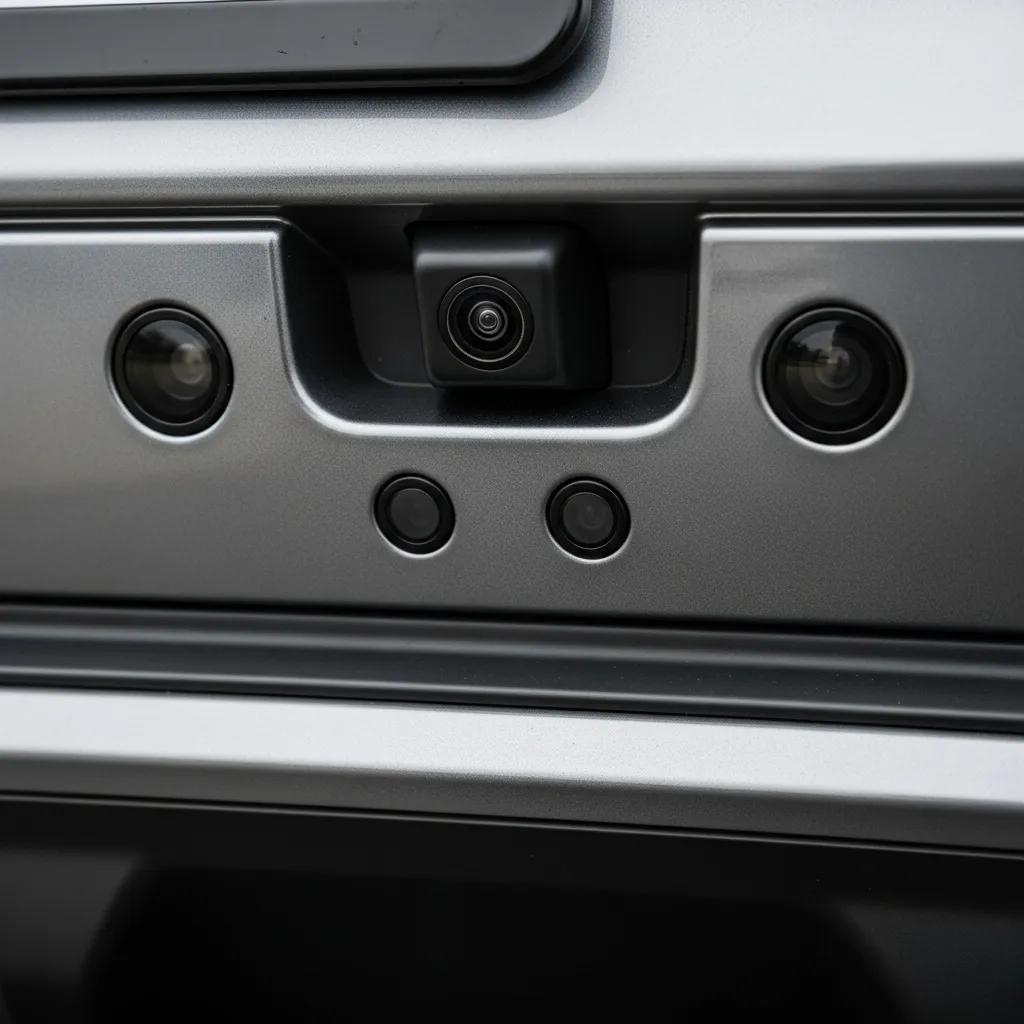
Ultrasonic sensors, cameras and, in some systems, radar modules are the core components. Ultrasonic sensors use sound to measure very short distances—perfect for close-range detection around bumpers. Cameras provide visual input for object recognition and path guidance so the ECU can distinguish pedestrians, curbs and nearby cars. Cameras can fail if a lens is cracked, misaligned or blocked. Radar, when included, gives robust distance and velocity data for moving objects. The ECU fuses all these inputs and translates them into steering and braking guidance. That’s why diagnostics typically focus on sensor housings, wiring harnesses and control-module codes to find the root cause of degraded park-assist performance.
What Types of Parking Assist Technology Exist?
Parking assist ranges from simple driver prompts to fully automated parking. Common modes include parallel and perpendicular park assist (where the system steers and you control speed), remote or valet parking (vehicle moves with a remote command), and fully automated parking that manages steering and speed. Simpler systems rely mainly on ultrasonic sensors and basic algorithms. More advanced setups add cameras, radar and tighter ECU integration to handle multi-step maneuvers. The table below gives a quick comparison of typical sensors, driver involvement and common use cases.
Different park-assist systems combine sensors and software in varying ways to deliver levels of automation that match different needs.
| Parking Assist Type | Typical Sensors | Driver Involvement |
|---|---|---|
| Parallel parking assist | Ultrasonic sensors, backup camera | Driver controls pedals; system steers |
| Perpendicular parking assist | Ultrasonic sensors, multiple cameras | Driver controls speed; system steers |
| Remote/valet parking assist | Cameras, radar, ultrasonic sensors | Vehicle maneuvers autonomously with remote command |
| Automated parking (full) | Cameras, radar, ECU-level integration | Minimal driver input; system handles steering and speed |
What Are the Benefits of Using Parking Assist Systems?
Parking assist reduces stress, cuts low-speed incidents and speeds up parking in crowded areas by automating complex spatial decisions. Those user benefits come from sensor-based obstacle detection and algorithmic path planning that lower human error in tight maneuvers and repetitive parking tasks. The bottom line: fewer bumper scrapes, less time circling for a spot and more confidence when squeezing into parallel or garage spaces. Here’s a quick summary to help you decide if park assist is worth it for daily driving.
In practical terms, parking assist delivers measurable advantages tied directly to how the system senses and plans.
- Reduced stress and effort: Guided or automated steering takes the hardest part of parking off your plate.
- Improved safety: Sensors spot low-speed obstacles and warn or intervene to prevent scrapes and collisions.
- Greater accessibility: Self-parking features help less-experienced drivers and make tight-city parking more manageable.
How Do Parking Assist Systems Reduce Driver Stress and Effort?
By handling spatial calculations and fine steering inputs, parking assist shrinks the mental load of tricky parking maneuvers. On a busy street or in a narrow garage, the system scans available space, computes a path and provides steering corrections while you focus on speed and surroundings. That cuts down on repeated adjustments, saves time and reduces the risk to nearby vehicles. As drivers trust these features more, parking becomes less stressful and avoids unnecessary curb or bumper contacts. That ergonomic benefit also ties directly into the safety improvements park assist offers.
In What Ways Do Parking Assist Systems Improve Safety?
Park-assist systems improve safety by detecting obstacles below or around the driver’s natural sightline and by reducing human error during low-speed maneuvers. Ultrasonic sensors and cameras can spot curbs, poles, small objects, pets and children; the ECU then warns the driver or nudges steering to avoid contact. But safety relies on correct calibration—misaligned sensors or a damaged camera can cause false alerts or missed detections. Routine maintenance, recalibration after collisions and attentive driving together preserve the safety benefits of parking assist. That brings us to what to watch for after an accident and which damages most commonly affect system performance.
| Benefit | Mechanism | Driver Outcome |
|---|---|---|
| Reduced stress | Automation of steering and path planning | Faster, calmer parking in tight spots |
| Fewer minor collisions | Sensor-based obstacle detection and alerts | Reduced repair costs and insurance claims |
| Increased accessibility | Assisted maneuvers support less-experienced drivers | Wider usability and confidence in parking |
How Does a Collision Affect Your Parking Assist System?
Even a low-speed bump can knock sensors out of position, crack a camera lens or damage wiring and control modules—any of which will reduce parking assist accuracy. The ECU depends on precise geometry: a few millimeters of sensor shift can create errors. Warning lights, dashboard messages, unusual beeps or inconsistent distance readings are common signs a sensor or calibration issue exists. If you spot those, don’t keep relying on the system—get a certified ADAS inspection and recalibration to restore correct alignment and safe operation.
After an accident, start with a quick visual check and then schedule professional diagnostics to confirm sensor and ECU condition.
- Perform a visual check: Look for cracks, dents or sensor misalignment on bumpers and camera mounts.
- Note any system warnings: Record error messages and alerts to share with your technician.
- Avoid relying on the feature: Drive carefully and don’t depend on park assist until it’s inspected and, if needed, recalibrated.
Professional inspection and ADAS recalibration restore sensors to factory tolerances and verify park-assist function against manufacturer specs. Local shops that specialize in OEM-quality ADAS work can handle this end-to-end. Prime Time Collision Center performs thorough ADAS inspections and recalibrations using manufacturer-aligned procedures, and we offer free 24/7 towing and free estimates to make post-collision logistics easier. Our I‑CAR Platinum technicians follow OEM-equivalent repair practices for sensor replacement, wiring repairs and control-module diagnostics, then run calibration and verification drives to confirm everything is back to spec. Choosing a certified shop lowers the chance of lingering misalignment and helps keep your vehicle safe long term.
What Types of Damage Can Impact Parking Assist Components?
Common issues after an impact include bumper deformation, damaged sensor housings, cracked camera lenses, torn wiring harnesses and ECU faults—each can break the sensor fusion the system relies on. A shifted bumper can change ultrasonic sensor angles and produce false distance readings. Camera scratches or misalignment skew visual perspective and affect object recognition. Electrical problems—frayed connectors or control-module errors—can interrupt data or corrupt fusion logic, leading to intermittent or total system failure. Knowing these failure modes helps technicians and owners focus inspections and decide whether repair, replacement or recalibration is required.
Why Is ADAS Recalibration Critical After an Accident?
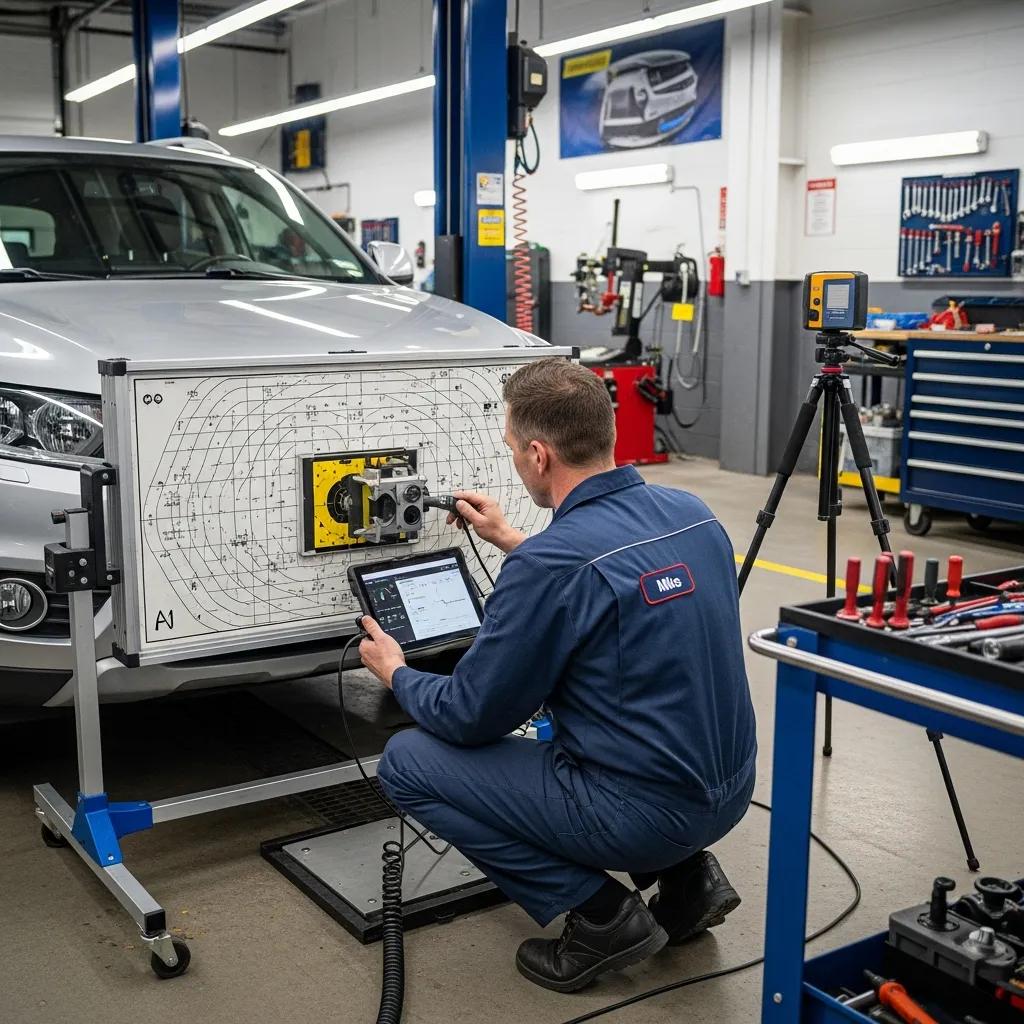
ADAS recalibration realigns sensors and cameras to manufacturer tolerances so the ECU reads distances and angles correctly. Without it, a misaligned sensor can cause the system to under- or overestimate space and give unsafe guidance or fail to assist when needed. Recalibration combines diagnostic checks, mechanical alignment and software-based calibration using vehicle-specific manufacturer specs. Certified recalibration follows OEM procedures and tooling to re-establish correct tolerances and includes verification testing to confirm system outputs. In short: recalibration restores safety and the convenience you expect from parking assist.
| Repair Option | Risk/Benefit | Impact on ADAS |
|---|---|---|
| OEM-certified repair | Uses manufacturer procedures and parts; higher accuracy | Restores sensor alignment and system reliability |
| Aftermarket/uncertified repair | Lower cost but variable procedures | Risk of misalignment and reduced ADAS performance |
| DIY/partial fixes | Quick cosmetic fixes without calibration | Can leave sensors misaligned and compromise safety |
Why Choose OEM Certified Repairs for Parking Assist Systems?
OEM-certified repairs follow the vehicle maker’s procedures, use specified parts and apply exact calibration methods that preserve accuracy and safety for parking assist and other ADAS features. Sticking to OEM standards reduces the chance of misalignment, keeps software compatibility intact and helps the self-parking features behave as designed. Aftermarket or uncertified repairs can use different parts, skip calibration steps or alter sensor placement—any of which risks sensor-fusion errors and degraded reliability. Certifications like I‑CAR Platinum show that a shop has invested in advanced training and systems to meet modern repair needs, giving you more confidence in the outcome.
What Does OEM Certification Mean for Your Vehicle’s Technology?
OEM certification means repairs and calibrations are completed to the vehicle maker’s specs with the tools and processes needed to restore original sensor geometry and ECU parameters. These procedures spell out exact alignment tolerances, calibration sequences and verification tests so the parking assist reports accurate distances and paths. Using OEM-equivalent parts and following documented processes helps the integrated systems—cameras, ultrasonic sensors, radar modules and the ECU—work together as engineered, preserving safety, convenience and the vehicle’s value. That’s why certified repair paths are recommended after collisions.
How Do I-CAR Platinum Certified Technicians Ensure Expert ADAS Repair?
I‑CAR Platinum certification shows a facility has invested in advanced training and infrastructure for complex collision and ADAS work. Certified technicians are trained on the latest vehicle tech, calibration procedures and diagnostics needed to find sensor damage, repair wiring and execute precise recalibration. Their training reduces calibration errors and includes full system verification—often with test drives—to validate parking assist accuracy. For vehicle owners, a shop staffed by I‑CAR Platinum technicians means a higher likelihood the repair will follow recommended steps and restore the vehicle’s safety systems correctly.
How Can Prime Time Collision Center Help with Parking Assist System Repairs?
Prime Time Collision Center is a local collision and auto-body shop focused on OEM-quality repairs, insurance-claim support and building trust with customers across Glendale, Burbank, Pasadena and Los Angeles. Our team includes I‑CAR Platinum certified technicians who follow OEM-equivalent procedures for sensor repair and ADAS recalibration to restore parking assist after accidents. To make the process easier, we offer free 24/7 towing and free estimates so your vehicle can reach a qualified shop quickly and diagnostics can begin without extra hassle. Our lifetime warranty on repairs gives long-term confidence in both structural and electronic work—clear benefits when you’re dealing with parking-assist system repairs.
What Is Prime Time Collision’s Process for ADAS Recalibration?
Our ADAS recalibration process is organized and transparent so you know what to expect. First, we run a visual and diagnostic inspection to find physical sensor damage, camera misalignment or control-module faults and to record system fault codes. Next, our technicians perform required repairs using OEM-quality parts or equivalent procedures—this may include bumper work, sensor housing replacement, wiring repairs and camera mounts. Finally, we use calibrated tools and manufacturer-specific software to recalibrate sensors and cameras to factory tolerances, then complete a post-calibration test drive and verification to confirm restored functionality. That stepwise approach ensures your parking assist system is not just fixed but validated for safe use.
- Initial inspection and diagnostics: Identify damage and capture system codes for a targeted repair plan.
- OEM-equivalent repair: Replace or repair sensors, cameras and wiring following manufacturer guidance.
- Calibration and verification: Use manufacturer tools to recalibrate and test the system before release.
This process reduces uncertainty for owners by connecting the initial assessment to final system validation.
How Does Prime Time Collision Simplify Insurance Claims for ADAS Repairs?
We work with all major insurance companies to streamline estimates, document OEM repair rationale and advocate for necessary ADAS recalibration. Our shop prepares evidence-backed repair plans and calibration procedures that explain why sensor replacement or recalibration is required to meet safety standards—this helps speed approvals and reduce disputes. Free towing and free estimates cut customer hassle early in the claims process and ensure accurate repair scopes are submitted to insurers. Combined with certification and a lifetime warranty, these services make the path from incident to restored vehicle safety smoother.
What Should Drivers Know About Parking Assist System Safety and Limitations?
Parking assist is a powerful aid—but it has limits. Adverse weather, sensor obstruction and odd-shaped or low-contrast objects can reduce detection and decision-making, so you must stay attentive when using these features. Heavy rain, snow, mud or road grime can block ultrasonic sensors or blur cameras; small, low-contrast obstacles like curbs or short posts may be missed or misclassified. Systems also depend on correct calibration—any recent collision or bodywork should trigger an inspection and possible recalibration. Drivers who understand these limits get the most from parking assist by combining it with visual checks and routine maintenance like sensor cleaning and post-repair verification.
What Are Common Limitations of Parking Assist Technology?
Common limitations include sensor blockage from dirt or snow, reduced performance in extreme weather, and trouble detecting small or low-contrast objects—each can cause false alerts or missed obstacles. Ultrasonic sensors struggle when housings are covered; cameras suffer from glare, condensation or scratched lenses. Radar performs better in poor visibility but not every system includes it, so redundancy varies by vehicle. Knowing these constraints helps drivers do quick pre-use checks—clean sensors, clear camera lenses and heed warnings—before relying on automated assistance in complex situations.
How Can Drivers Maximize Safety When Using Parking Assist Features?
Maximize safety with simple routines: keep sensors and cameras clean, pay attention to system warnings, and schedule certified recalibration after any collision or structural repair. Do a quick visual check before using park assist, watch for dashboard alerts, and combine sensor guidance with direct observation until you’re comfortable with system behavior. If warning lights or inconsistent distances appear, stop using the automated function and book an inspection with a qualified technician for diagnostics and recalibration. Regular attention to these steps preserves the convenience of self-parking while avoiding overreliance on compromised systems.
- Sensor cleaning: Gently wipe cameras and ultrasonic sensor housings to prevent obstruction.
- Heed warnings: Treat system alerts as prompts for inspection, not mere annoyances.
- Post-collision inspection: Get certified calibration after impacts to restore proper performance.
These habits keep parking assist reliable and complement professional repairs when technical issues arise.
Frequently Asked Questions
1. How often should I have my parking assist system inspected?
We recommend an inspection at least once a year, or sooner if you see warning lights, error messages or inconsistent behavior. After any collision or significant impact, schedule a full inspection and recalibration to ensure the system is working correctly. Regular checks help catch issues early and keep parking assist reliable.
2. Can I clean the sensors and cameras myself?
Yes. Use a soft, lint-free cloth and a gentle cleaner to wipe lenses and sensor housings. Avoid abrasive pads that can scratch surfaces. Regular cleaning prevents dirt, salt or snow from obstructing sensors and helps maintain accurate detections.
3. What should I do if my parking assist system is not working properly?
First, look for visible damage to sensors or cameras and note any dashboard warnings or error codes. Don’t rely on the feature until it’s inspected. Schedule a diagnostic with a qualified technician who can identify the issue and recommend repair or recalibration.
4. Are there any specific driving conditions that can affect parking assist performance?
Yes. Heavy rain, snow, fog, glare and road grime can impair sensors and cameras. Unusual object shapes or low-contrast obstacles—like short posts or curbs—may be missed. Always use visual checks in challenging conditions and treat system alerts seriously.
5. How does parking assist technology differ between vehicle models?
Systems vary by model. Some offer basic ultrasonic proximity sensors, while others combine cameras and radar for richer object recognition and automated parking. Driver involvement also differs—some systems need more manual input than others. Check your vehicle’s manual for specifics about your model.
6. What are the risks of using aftermarket parts for parking assist repairs?
Aftermarket parts can be lower cost but may not meet OEM specs, leading to sensor misalignment or inconsistent performance. Improper installation or skipped calibration can compromise safety. For ADAS systems, OEM-certified repairs are the safer choice to ensure compatibility and correct function.
7. How can I ensure my parking assist system remains reliable over time?
Keep sensors and cameras clean, schedule routine inspections (at least yearly), and address warning lights promptly. After any collision or bodywork, get professional recalibration to restore factory specifications. Combining regular care with certified service maximizes the system’s lifespan and reliability.
Conclusion
Parking assist systems make parking easier by reducing stress, improving safety and increasing accessibility in tight spaces. Knowing how the technology works—and why proper calibration matters after impacts—helps you get the most from these features while avoiding risks. For best results, schedule routine inspections and professional recalibrations after incidents. If you need help, explore our ADAS and parking-assist repair services to keep your system working like it should.